
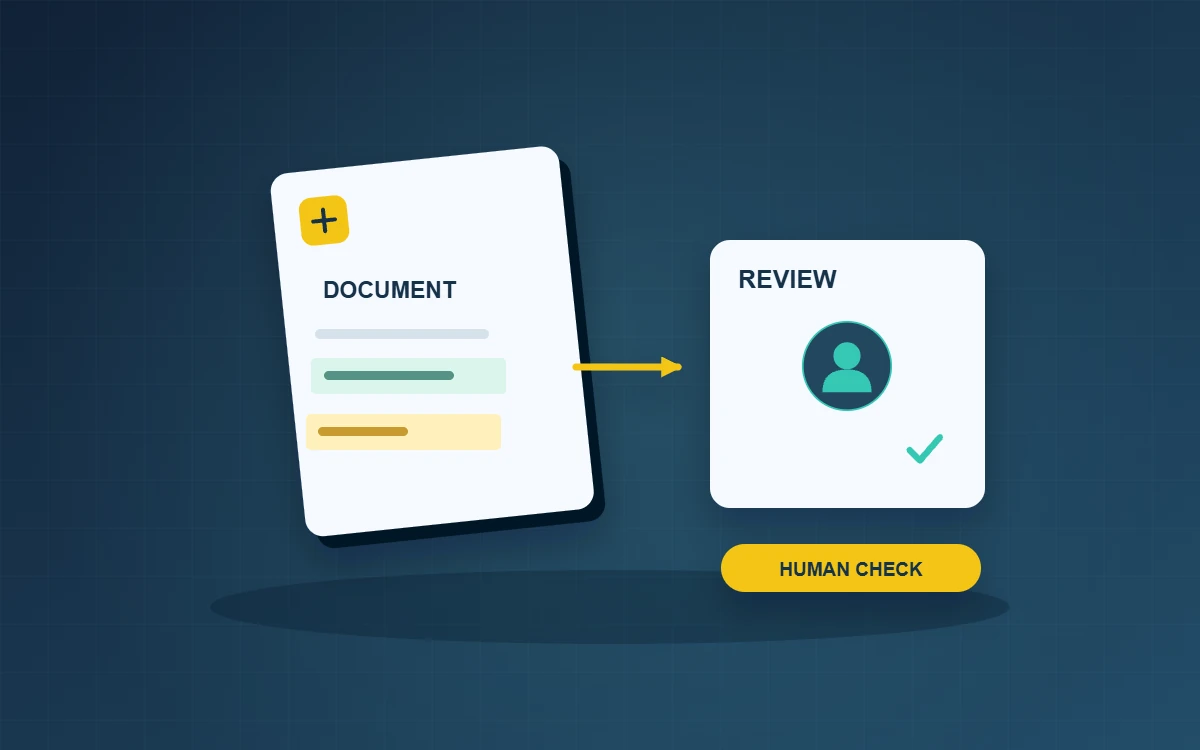
Place human review in AI document processing after field extraction and before high-impact or unresolved values enter a final record. For supplier invoices, give authorised staff the original evidence and keep payment approval in the existing workflow. The system can flag discrepancies between an invoice and its purchase order. Retain the original document, extracted result, human correction and final approval as distinct records for later review.
Decide what each field can affect
List the values you want to extract and describe the consequence of each kind of error. An incomplete note might be flagged for later follow-up. A change to the amount, currency, bank details or supplier identity can affect payment and deserves review by an authorised colleague. Give reviewers both the extracted value and its location in the original document. The existing payment approval process should still control whether a payment is authorised.
Test documents that reflect actual conditions
- Include clear scans, blurred photos, tables spanning multiple pages and unfamiliar layouts.
- Create verified answers using fictional records or documents approved for testing.
- Test duplicate invoice numbers, totals that differ from line items and currencies that do not match the purchase order.
- Record how long review takes, what staff correct and whether an unresolved exception can reach the next step.
Give reviewers a clear way to resolve exceptions
Suppose a two-page invoice has a total that differs from its line items. A reviewer traces the result to the first page and discovers the system included a subtotal twice. The reviewer corrects the field and records why. If bank details differ from the approved supplier record, the reviewer escalates through the existing verification process. Offer a way to return an unreadable document and preserve the reviewer, evidence, decision and timestamp.
Use evidence from the pilot to adjust review rules
Microsoft’s Document Intelligence documentation describes confidence scores as estimates that can help flag results for review. NIST’s generative AI risk profile provides guidance on evaluation and governance. Compare errors by field and document type, the time colleagues spend reviewing and any exceptions the process missed. Use that evidence to decide which low-impact fields can be sampled. Limit access to documents, analysis output and review logs, and set a retention period for each.
Track the age of the oldest pending review alongside extraction accuracy. A full review queue can create pressure to approve records too quickly. When volumes exceed what the team can handle, narrow the pilot or reserve review capacity for the highest-impact documents. Recheck the queue with the people who actually process it.
Frequently asked questions
Can a high confidence score replace a reviewer?
Treat the score as one input. Base the decision on the consequences of a mistake, the applicable business rules and evidence from representative documents.
Does the reviewer need to see the entire document?
Show the relevant field and original text first. Give authorised reviewers access to the other pages when they need more context.
When should we repeat the pilot tests?
Repeat the fixed test cases and add representative samples when the document layout, model, data source or rules change.